Beware: White Woman on Wheels

Last week, I finally pulled the trigger and bought a car in Tamale. This is both good and bad news. Good, because I now have more mobility and safety and no longer need to rely on yellow yellows to get around places (especially after dark when it’s not a great idea to catch ones off the street). Bad, because it put a significant dent in my savings and because the experience of driving in Tamale is constantly mildly terrifying.

Let me mostly elaborate on the “bad”, not because I want to dwell on the negative but because those experiences make for much more entertaining blog material.

As with all purchases in Tamale, I had to pay for the car up front and entirely in cash. Thankfully, the seller was a friend of my colleague Ben, so Ben was able to make an arrangement with him whereby I would pay half the price upon getting the car, and the other half one week later. This turned out to be a good call, as I have since heard a handful of horror stories from friends about instances in which people paid for their car up front, only to have the seller take the money but then turn around and sell it to someone else. Nonetheless, even with this two-installment payment deal, it was a lot of cash to procure. So, for the last two weeks, I have been running around Tamale like a madwoman in order to withdraw all the money I needed to pay (I was paranoid of being recognized if I visited the same ATM multiple times, so I went around to different ATMs throughout town). The whole process was so comically absurd and inefficient, and yet at the end of it all the only thing I received was a handwritten paper receipt on which the seller had scrawled my name and the total amount paid. Hey, it was better than nothing!

If I thought that was the hard part, I was sorely mistaken. Before being able to drive the car, I had to go to the DVLA (the Driver and Vehicle Licensing Agency, which is Ghana’s version of the DMV) to complete all the paperwork necessary to register the car in my name. Let me set the scene: imagine being in the most convoluted, red tape-laden bureaucratic process you can think of. Now imagine that while that is happening, it is 100 degrees outside and you are sitting in rooms with no A/C and fans that are more decorative than they are functional, and all along the way you are being required to pay little bribes to each person you interact with (“oh, just give me something small” they would all say). Finally, 3 days, 4 separate visits, and at least 100 cedis worth of bribe money later (that’s roughly 20 dollars – which I know isn’t a lot but it was more about the principle than the amount itself), I walked out with a car that had successfully completed the registration process and a 0% understanding of how that process actually worked. I was laughing by the end, although whether out of relief or a heat-and-confusion-induced delirium I could not tell you.

Now that I have the car, things are mostly good. The only downside is the driving itself. Kidding! (But only kind of.) Thankfully, my commute from home to the office involves just three turns and takes less than ten minutes. But all along the way, I have to be vigilant of careening yellow yellows and motorcycles, plus bicyclists and pedestrians that always seem to dart out of nowhere – and that’s only the human traffic! Goats here love (despite, you would think, survival instincts) laying down in the middle of the road for a snooze. Where I live there are also lots of meandering dogs, chickens, guinea fowls, and the occasional cow. I nearly cried coming home from work yesterday because a baby chicken suddenly waddled right in front of my car and I thought I ran it over (thankfully, I did not).

The main system of traffic is not stop signs or traffic signals but just good old-fashioned honking. I have been trying to learn when it’s appropriate, and even necessary, to honk (and learning how to honk! For example, when should you give a few toots vs. really lay down the horn?) but in all honesty I have no clue what I am doing. During my first week driving, I was so nervous that I basically just honked every time I made a move on the road. Turning out onto the main street? Beep beep. Slowing down to go over a speed bump? Beep beep. Entering a roundabout? Beep. Exiting a roundabout? Beep. Swerving to avoid a goat that appeared out of nowhere? Beep beep beep!

To be fair, the decision to get a car was entirely my own. After five months of living here, I knew why I felt it was necessary and I understood more or less what I would be signing up for. By now I am aware that, as with all kinds of change, driving will likely just take some time to get used to. And the peace of mind that comes with having the ability to move myself around safely and on my own schedule is immeasurable. I may be considered a white woman here, but at least now I’m a white woman on wheels. Watch out!
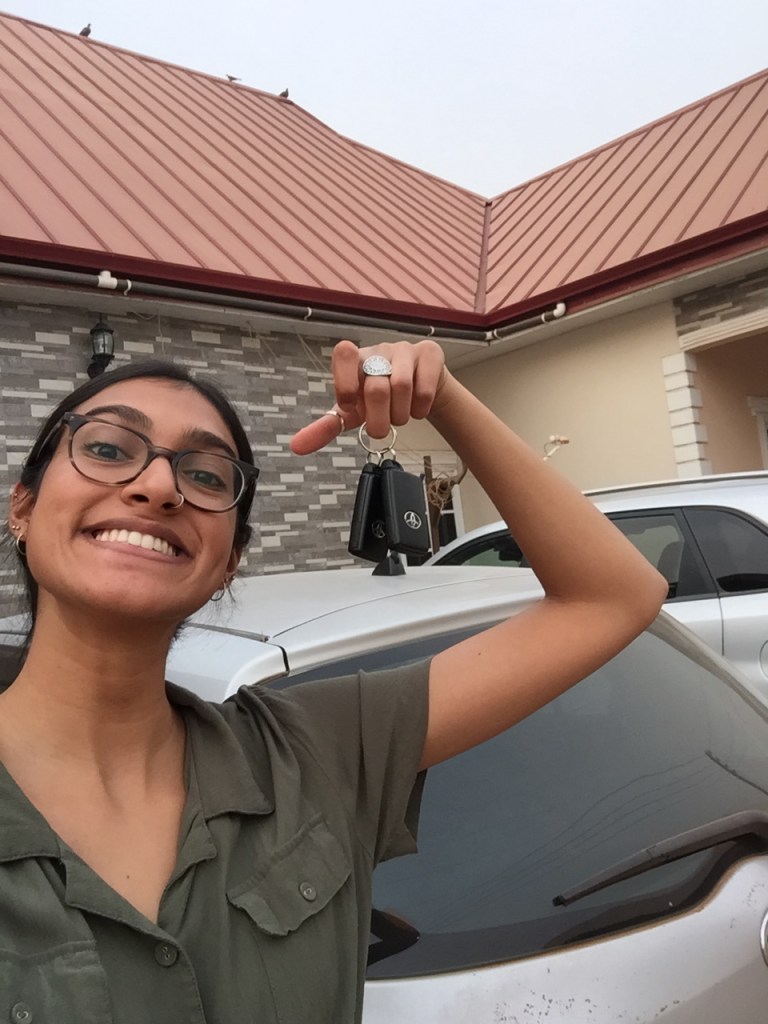
Brand new car owner!
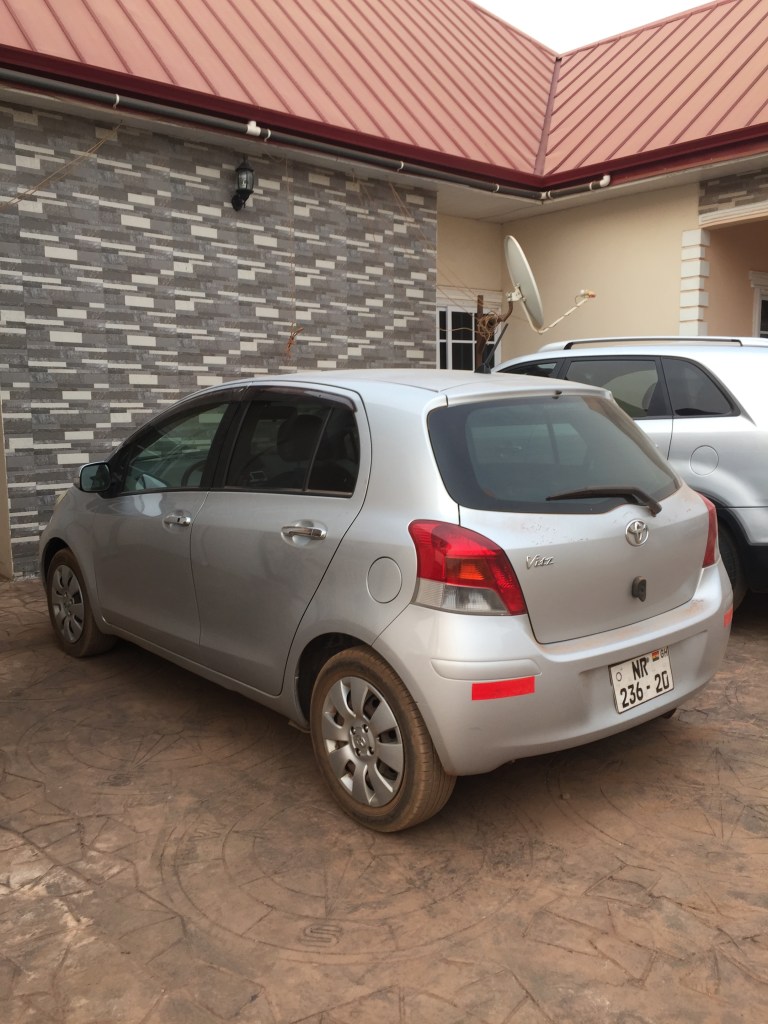
My car: a silver Toyota Yaris

Resolute

Greetings on the last day of the year! After coming home for the holidays, I returned to Ghana yesterday. For the moment I am in Accra, spending a few days here as a buffer to ease the transition from Chicago back to Tamale (and also to squeeze in some last minute shopping).

Returning home has never before felt like as much of a homecoming as it did this time around. From the moment I was greeted by my entire family at the airport with a big “Welcome Home, Siliminga” sign, I felt such contentment to be back with loved ones. The week went by far too fast, but I think that’s just because it was such a whirlwind of laughing, eating, complaining about eating too much, and goofing around together.

Aside from all the indulgence and relaxation I got to enjoy while home, it was also really nice to have some space away from this intensely immersive experience I had been having the last four months. It gave me some much needed perspective on what I had been doing, and by talking with lots of people about my plans for the upcoming year, it also helped me refocus my thoughts on what I wanted to improve upon or do differently. Essentially, it gave me chance to think about my goals for the new year, which I wanted to share here, even if they are only half-baked for now:

  • Be patient.
  • Find new ways to step outside my comfort zone.
  • Be a tourist/travel more within Ghana. Specifically, plan a trip to visit Kintampo Falls, Kumasi, and maybe the Volta Region.
  • Take care of myself by exercising more regularly. I have a yoga mat now so no excuses anymore!
  • Cook new recipes. Shout out to my mother for insisting I bring an Instant Pot back with me.
  • Learn how to make homemade bread.
  • Initiate more FaceTime/video calls with family and friends from home.
  • Write more.

I usually prefer the term goals to resolutions, but I thought it seemed fitting to name this post Resolute because it encompasses the state of mind I would like to have when I fly back to Tamale tomorrow. I left there a week ago feeling somewhat fatigued and uncertain; I want to return determined and with purpose.

P.S. If anyone has suggestions for the goals I wrote here, please reach out to me! Always open to new ideas.

More evidence, less poverty

The title above is the mission statement of the organization I work for here in Tamale, Innovations for Poverty Action or, as it is more commonly called, IPA (people in the NGO world love acronyms!)

In broad terms, what we do at IPA is partner with other development NGOs or country governments (e.g. the government of Ghana) to conduct impact evaluations that test the effectiveness of their programs on key outcomes they care about. We work in a wide range of sectors – education, financial inclusion, social protection etc. – so those outcomes could be anything from school enrollment rates to agricultural productivity.

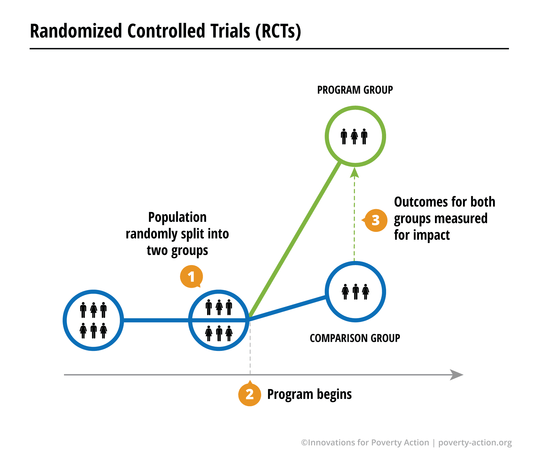
The main methodology we use to do this work is RCTs, which stands for a randomized control trial. These are commonly used in medicine and are known as clinical trials, but the idea is essentially the same in the international development sector – we take a sample and randomly assign half to be in the treatment group and the other half to be in the comparison group. The treatment group receives some intervention (whatever the NGO or government program provides) while the comparison group receives nothing. Having the comparison group is critical because it tells us what would have happened in the absence of the program i.e. the counterfactual.

We collect data on both groups, and at the end of the study we evaluate the outcomes of the treatment group relative to the comparison group in order to determine whether the intervention made those who were treated better off, since the randomization ensures that the two groups should have been more or less identical prior to the study. The diagram below should help illustrate this concept.

If interested, you can read more about RCTs and why we at IPA use them to conduct evaluations here.

My official role with IPA is that of a senior research associate. It is not a particularly meaningful title, but basically what I do is manage one of the ongoing impact evaluations we are conducting here in northern Ghana. It is a study called Comparing Livelihood Approaches for the Ultra-Poor in Ghana (you can read the full IPA study description here).

Back in 2016, the lead researchers on the project randomly selected 7,330 households across 4 regions in northern Ghana to participate in the study. They were selected based on a poverty scorecard test, since the goal was to target the poorest households within each community where we would be working.

I won’t go into the weeds on the various treatment arms, but you can think of there being two main interventions: 1) a mental health intervention, which took place in the form of cognitive behavioral therapy sessions administered at the community level and 2) an economic intervention, which took place in the form of a livelihood program that our partner, an NGO called Heifer International, had been implementing previously and was willing to be evaluated on. The livelihood program has a lot of components: a productive asset transfer (households choose whether they want to receive goats, sheep, pigs, poultry, etc.), coaching visits to help them manage the asset, consumption support, access to savings, and health insurance. The idea behind this “package” style intervention is that there is no silver bullet for graduating someone out of poverty; rather, it takes many different things working together to help someone sustainably improve his or her livelihood.

Thus, we ended up with a study design in which there were 4 main treatment groups: 1) households that received only the mental health intervention 2) households that received only the economic intervention 3) households that received both interventions and 4) households that received nothing i.e. the comparison group. We are now three years into the study and conducting the final round of data collection on all these households. Once we do, we will aim to test the impacts of the various interventions. Of particular interest will be comparing those households who received both interventions to the households that only received one or the other, to examine whether there are added gains to treating both the psychological and economic dimensions of poverty.

When I began the role in August, my job was wholly focused on getting ready for the survey we were preparing to conduct on our sample of 7,000+ households. That meant programming the survey instrument, setting up a data management system, recruiting/hiring/training surveyors, procuring field logistics (tablets for data collection, backpacks, ID badges, etc.) and the like. It was an intense first few months, and was especially nerve-wracking as the time approached to actually launch the survey.

Now, we are fully in the swing of things – about 10 weeks into the survey period with things going more or less smoothly (there is always some shit hitting the fan, but at this point it’s become expected so I don’t stress too much). Usually once a week or so, I accompany one of our field managers to the actual communities we’re working in so that I can help monitor how the survey teams are doing . It is one of my favorite aspects of the role because I get to witness firsthand the very personal, very genuine interactions that our team has with the actual study participants.

When I sit in on interviews, I am always amazed at how the respondents – regardless of their economic situation – so generously give us their time and attention, so willingly engage with us even though they know they don’t receive any money for doing so. When we enter a compound, we are immediately greeted (“Despa” for good morning or “Anterri” for good afternoon), followed by a flurry of movements as someone rushes to find us stools or chairs to sit on, as we are their guests. We usually seat ourselves in a shaded hut, with chickens or goats casually strolling through every now and then to pluck at stray maize kernels on the ground.

For me especially, it is eye-opening to see how the data is collected at its very source. I sit there knowing that the words exchanged between respondent and surveyor will eventually translate into a mere observation within a larger dataset, the nuance lost and the sentiment removed. That data will be aggregated, analyzed, and summarized – used as evidence of how the program works and communicated to policymakers or other researchers. But in the moment, the people speaking with us are what matter most. They give my work meaning and they humble me immensely.

The U-curve of cultural adaptation

Whether it’s because work has been building up or because, as the holidays approach, I long to be home with family, I have lately felt overcome with a lot of doubt. Doubt about whether I am strong enough to do this, doubt about whether this was the right career move, doubt about whether I will be able to ever fully adjust to living here. I look at some of the expats who seem so settled, who have forged routines and rituals that center their lives here, and I feel very unrooted by contrast.

The thing that has been most unsettling in the last few weeks is the anger I have been feeling. I am normally not an angry person (although without coffee, definitely a cranky one) but there are times when I feel so helpless or exasperated which, compounded by the feeling of being alone, then builds into frustration. After some time, the little frustrations that would normally dissipate on their own instead boil over into anger because they remain unresolved.

One example is the situation with my housing. In Ghana, you are required to pay a full year’s rent up front in cash. Having done so, I am essentially locked in to my housing decision, since moving would imply that I lose the remaining 8 months of rent I have already paid for but not yet used. I was uneasy with this aspect of the rental agreement to begin with, but the fact that my house has had a number of issues since I moved in makes it all the more frustrating. Whether it was the security guard who supposedly came with the house conveniently leaving the day before I moved in or the floors sinking or the gutter leaking or the circuit board shorting or the shower knob shocking me or the power going out, I have had the full range of home repair needs.

Each of these problems is manageable as a stand-alone issue, but altogether and over the course of time they have come to feel overwhelming. I am fortunate to have a landlord who is fairly receptive anytime I do raise an issue, but even so it frustrates me that there seems to be this never-ending series of mishaps that, more often than not, I have to deal with on my own because telling someone to fix the issue isn’t enough to ensure anything will actually get done (and get done properly). And in the meantime, it makes it hard for my house to feel like an actual home, a place where I can seek quiet refuge at the end of a long, hot day

This type of thing happens in many settings – at work, at restaurants, at the market etc. The general pattern is always the same: things don’t happen as expected or as planned, little frustrations arise, nothing is done about them, the little frustrations snowball into anger, the anger builds inside me (I feel like I am careening to the point at which it all erupts in some sort of dramatic meltdown, but I would really like to avoid happening).

A large part of the anger I feel in these situations is directed toward myself. Often, I am angry for feeling angry. I tell myself that I should be more open-minded and less uptight, or that I should let go of the cultural expectations I have as an American and be more understanding of what the cultural norms are here.

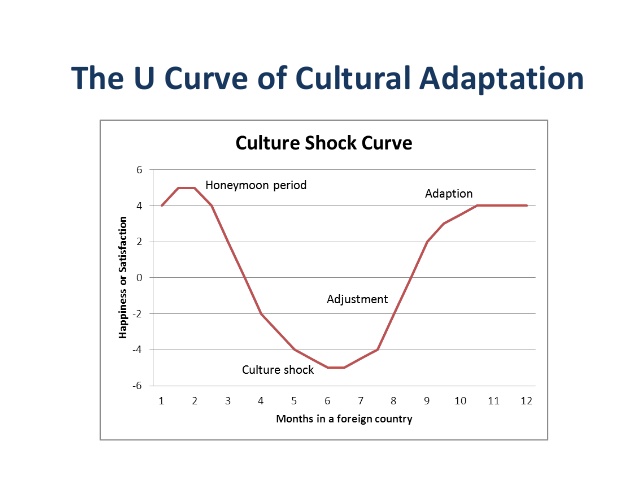
A few days ago, I was sitting with a friend and ended up confiding in her that I had been holding on to these feelings and didn’t know how to deal with them productively, but that I was afraid I might explode if I didn’t do something. She helped normalize what I was experiencing, saying that it was all part of the process of cultural adaptation. She even pointed me to this diagram (see below), which illustrates the typical stages that are experienced when adjusting to a new culture. As it turns out, I seem to be very much in the throes of the culture shock stage.

In some sense, it is helpful to know that I am not just a poorly-adjusted person with an uncontrollable rage problem. It also helps to calm some of the self-doubt that has been creeping into my thoughts. But at the same time, it still feels a bit disheartening to have lived somewhere for four months and still feel so unadjusted, so at odds with the environment you are in.

I am so looking forward to coming home for the holidays in a few weeks, but part of me is also fearful. I know that I am in a delicate place right now – teetering between feeling committed to being here and feeling tempted to give up. And I fear that actually coming home and being reminded of the things that are familiar and comforting will reset the culture shock all over again when I return to Tamale.

For now, all I know is that if the process of cultural adaptation truly is U-curved in shape, then at some point it must get better. I think, for my own sanity, I just have to keep reminding myself that each day I am here, there is growth happening – I become a little more tolerant, a little more resilient, a little more in tune with the culture and the people in this place.

Home away from home

I want to write about the process of finding community in a place that feels far from home. I am sure that loneliness is not an uncommon experience among expats – it is easy to feel isolated living away from your friends and family, trying to navigate new and often challenging environments. I myself have felt lonely often since being here, both in a physical sense and an emotional one.

It helps to talk with loved ones from home, but even then it usually feels like something is missing. I think it’s the need to have people around you who can relate to your experiences and offer empathy. The people I talk to from back home are somewhat limited in their capacity to empathize, not because of any kind of shortcoming of their own but simply because they live in a world apart from the one I now inhabit and sometimes cannot relate to the experiences I have.

All this is to say that I have realized how important it is here to find a community of people who understand your challenges and can offer, if not suggestions or advice, then at least their own story of dealing with the same issue so that the two of you can commiserate. I feel fortunate because this community in Tamale is wonderfully open-hearted and has welcomed me in from the very beginning.

In the time that I have been here, this group of people (largely expats, but some locals too) is the thing I have come to treasure most deeply. It is not a group of people who pity each other for the “third world” challenges they encounter or whine about the comforts they miss from home. Rather, it’s a network of incredibly resilient and generous people who look out for each other and help one another find humor and hope while living here.

Because this community is small in Tamale, there is even a WhatsApp group we are all part of. Sometimes the questions people pose to one another in the group are as simple as “Hey, does anyone know of a good electrician?” or “Does anyone know if mangoes are still being sold in town?” Sometimes, they are very practical in nature: “Which lab should I visit to get tested for malaria?” or “Does anyone have the number of a reliable yellow yellow driver they could share?” And on occasion, they are difficult or sensitive: “The stipend my company pays me isn’t enough to cover my living expenses – how should I ask them for a raise?” or “I keep getting harassed by the group of men who linger near my house in the evenings – what should I do?”

So even though Thanksgiving has now come and gone, it is this community of people I am most thankful for. In a setting where it’s easy to feel alone and apart from everyone else, they have made this place feel at least a little like home.

Greetings, from Ghana!

I finally committed to writing a blog about my time here in Ghana because I thought that the exercise of recounting my experiences and telling them in some sort of reflective, even comedic, way might help me to feel more accepting of them myself.

First, a little background for those who don’t know. In August, I began an eighteen month assignment working as a senior research associate with an organization called Innovations for Poverty Action (IPA). I plan to write a separate post explaining more about the work they do and my role specifically but for now, check out their website if interested in learning more. I am currently based in Tamale, the third-largest city in Ghana, which is located in the northern region of the country.

Tamale is an incredibly interesting place to live. There is a small but very vibrant community of expats (since much of the development work in the country is based in the north, there are numerous NGOs based here). Overall, the population is around 350,000. There is no mall or movie theater or sidewalks or public transport (aside from shared taxis and yellow yellows). To buy groceries you have to visit the central market in town or purchase from vendors selling at street-side stands. There are goats everywhere, with a sprinkling of stray dogs and cats, cows, chickens, and guinea fowl. It is extremely hot, and now that we are entering the dry season (called the harmattan), it has become very dusty as well. And since the majority of people are Muslim, almost anywhere you go you can hear the call to prayer emanating from mosques all throughout town.

Over the course of the three months in which I have been living here in Ghana, there have been innumerable ups as well as downs. Some moments have been tremendously rewarding or humbling; others have been so frustrating or bewildering they have brought me to a near (or sometimes, actual) meltdown points. Reflexively, I always tried to move past the unpleasant experiences as quickly as possible, but I am starting to think there’s actually something productive, even therapeutic, in revisiting them to try to better understand and sometimes make light of the situations.

Just to give some examples of the things I’ve encountered so far:

  • Trying to startle a lizard on the wall so it would scurry away, but instead it got scared, fell off the wall and landed on my bed
  • Losing power in 100 degree weather and soaking my clothes in the shower in a desperate attempt to stay cool
  • Having our office get flooded by rains
  • Waking up in a hotel to find my arms and legs covered in bed bug bites
  • Traveling for hours in a car with no A/C (almost no cars here have working A/Cs)
  • Walking past burning heaps of garbage in my neighborhood – very few people use actual trash collection services and instead just burn their waste
  • Trying to give directions to a friend’s house – since there is no formal address system in Tamale, finding new locations can be a real adventure! It usually requires a mix of having a pin location on Google maps, knowing the nearby landmarks, and asking at least two people for directions along the way

All of this is to say that living in Tamale is not without its challenges, and I have had to learn very quickly to manage my expectations and make peace with the fact that there will sometimes be discomfort. Nonetheless, I have also had many enjoyable moments since being here, and it seems only fair to share some of the more funny/heart-warming stories too:

  • Passing through town with random people calling out to me by saying “Siliminga, hello!” (Siliminga is the Dagbani word for a white person/foreigner)
  • Getting ponded my first week at the office – ponding is a tradition the IPA Ghana office has where they put you in a chair in the front yard and then everyone proceeds to gather buckets of water and they drench you
  • Finding random imported goodies in street-side convenience shops, like Aunt Jemima pancake mix or Kirkland brand almond milk
  • Heading to Chucks on Friday nights for pizza & beer with friends – Chucks is the main expat hangout spot in town, and pretty much everyone goes there on Fridays since there are so few restaurants in Tamale
  • My personal favorite story (and the reason behind the name of this blog): traveling to the field with my colleagues and having the local children run up to us because they had never seen foreigners before. They looked at my supervisor Erin, who is also American, and said in the local language, “Hey, a white lady!” Then they looked at me and my brown skin and exclaimed, “Hey look, this one is ripening!”
Design a site like this with WordPress.com
Get started